Vermeer's Secret: Light, Silence, and the Everyday
Vermeer painted ordinary rooms in ordinary light with such luminous precision that they feel suspended in a time outside of time.
Masters of Light
- 1.Masters of Light: Five Artists Who Made Darkness Speak
- 2.Vermeer's Secret: Light, Silence, and the Everyday
- 3.Rembrandt: The Master of Light and Shadow
- 4.Claude Monet and the Language of Light
- 5.San Giorgio Maggiore at Dusk: Monet's Venice in Dissolving Light
- 6.Van Gogh's Garden at Arles: Color, Joy, and the South of France
Johannes Vermeer produced roughly 34 known paintings in his entire career. He spent his life in Delft, never traveled far, and died leaving behind substantial debts and eleven children. He was largely forgotten for two centuries. When he was rediscovered in the mid-nineteenth century, it was with something approaching astonishment: how had this painter been overlooked?
The Interior World
Almost all of Vermeer's paintings depict the same room — or a room very like it — in his house in Delft. A window on the left admits cool northern light. A woman reads a letter, pours milk, plays a lute, or holds a balance. The compositions are quiet to the point of silence. Nothing dramatic is happening. And yet the paintings are impossible to leave.
The secret is light. Vermeer understood light as a physical force with material presence — the way it falls on a white wall, clings to the folds of a yellow jacket, turns the surface of milk into something luminous. He seems to have used a camera obscura to achieve his unprecedented accuracy of observation. Whether tool or no, the eye he brought to the task was extraordinary.
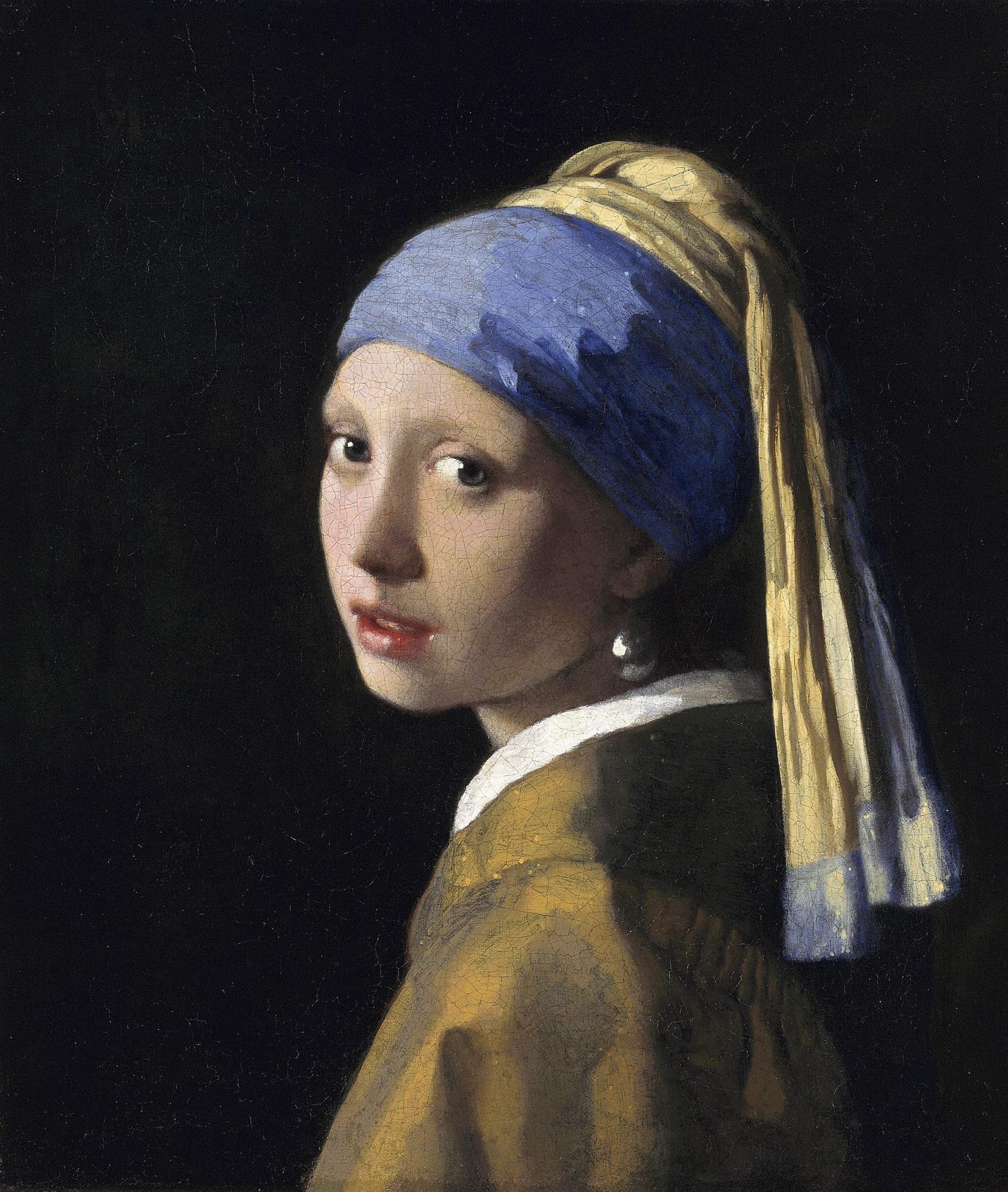
Girl with a Pearl Earring
Girl with a Pearl Earring (1665) is sometimes called the "Dutch Mona Lisa," and not just because of its fame. Like Leonardo's portrait, it derives its power from ambiguity. The girl turns toward the viewer — or toward someone just behind the viewer. Her lips are parted. Her expression is entirely legible and completely unreadable. The pearl earring catches the light with a precision that makes you want to reach out and touch it.
We know nothing about who she was. The painting has no title in Vermeer's hand. The ambiguity is not a puzzle to be solved; it is a condition of the work's power.
Slow Looking
Vermeer's paintings reward a kind of attention that our era makes difficult. They do not demand; they offer. Stand in front of one long enough and the light in the room begins to feel like the light in the painting — the same quality of cool, diffuse northern daylight that has changed very little in three and a half centuries. That continuity is what makes Vermeer's interiors feel less like history and more like a room you might step into.