Van Gogh's Garden at Arles: Color, Joy, and the South of France
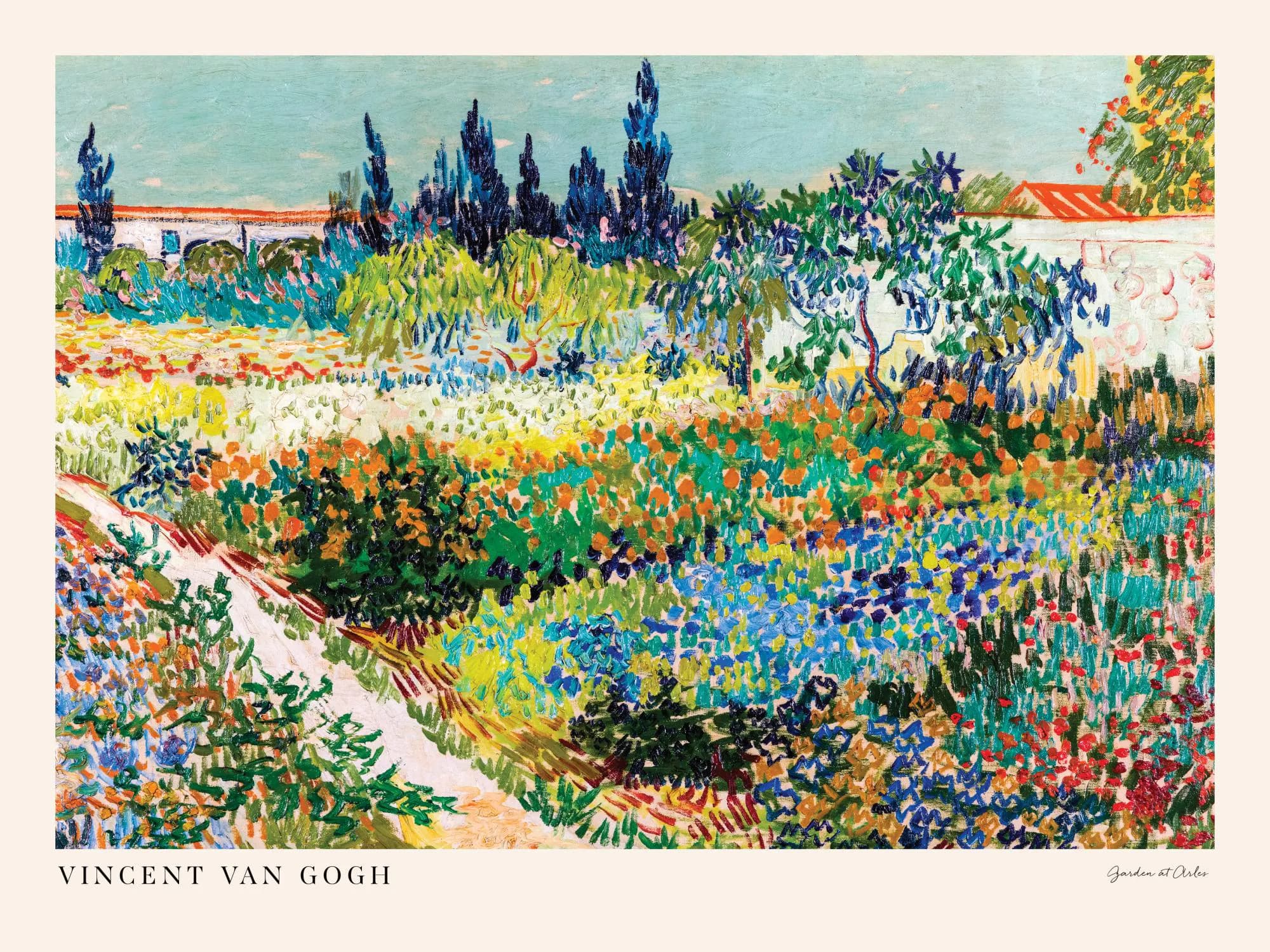
Van Gogh arrived in Arles looking for light. The garden paintings he made there — vibrant, urgent, trembling with color — are his most joyful.
Masters of Light
- 1.Masters of Light: Five Artists Who Made Darkness Speak
- 2.Vermeer's Secret: Light, Silence, and the Everyday
- 3.Rembrandt: The Master of Light and Shadow
- 4.Claude Monet and the Language of Light
- 5.San Giorgio Maggiore at Dusk: Monet's Venice in Dissolving Light
- 6.Van Gogh's Garden at Arles: Color, Joy, and the South of France
On February 20, 1888, Vincent van Gogh stepped off a train in Arles, in the south of France, into a landscape he had never seen before. The light was extraordinary — harder, brighter, and more colorful than anything he had known in the grey north. He had come looking for something, though he could not have named it precisely: a place where color might do the things he needed it to do, where the visual world would cooperate with his ambitions as a painter. Arles, he discovered almost immediately, was that place.
Arles: The Year of Transformation
The fifteen months Van Gogh spent in Arles represent the most productive and in many ways the most radiant period of his career. He produced over 200 paintings there, along with more than 100 drawings and watercolors. The subjects were those immediately around him: the town, the surrounding countryside, the night sky, the people he met, and — with particular intensity — the garden of the Yellow House, the modest dwelling he rented on the Place Lamartine and turned into the studio he had always dreamed of having.
The garden paintings made at Arles are distinct from everything Van Gogh made before or after. In the north — in Holland and in the Borinage — his palette had been dark, the colors of earth and shadow, of peasant labour and grey winter skies. In Paris he had lightened it, learning from the Impressionists. But in Arles, something broke open. The colors came up to full strength. The brushwork found its characteristic rhythm. The work became unmistakably itself.
The Garden as Subject
Van Gogh's garden paintings from Arles are not topographical records — he was not interested in documenting the garden as a botanist or landscape designer might. He was interested in the garden as a site of pure color relationship, as a place where the greens of grass and leaf and stem could be set against the yellows and oranges of flowers, the blues and purples of the sky and shadows, in combinations that felt simultaneously natural and invented.
The garden at the Yellow House was modest — a walled enclosure with some grass, flowerbeds, and trees. But Van Gogh transformed it, on canvas, into something more: a compressed version of the natural world organized by color rather than by botanical category, a place where every surface vibrates against every adjacent surface in a kind of organized excitement.
Brushwork as Energy
The technical achievement of Van Gogh's Arles garden paintings is the integration of color and mark into a single expressive unit. Each brushstroke is simultaneously a unit of color and a unit of energy — you feel the speed and pressure of its application, the direction of the painter's wrist, the particular intensity of his attention at the moment of making it. This is painting in which the act of painting is continuously visible, continuously present, which is part of what makes it feel so alive.
The thick impasto — paint applied so heavily it rises from the canvas surface — creates a texture that catches light differently depending on the viewing angle. A Van Gogh garden painting changes as you move in front of it: passages that seem flat from a distance reveal themselves as almost sculptural from the side. The physical substance of the paint becomes part of the meaning of the work.
Joy as a Painting Problem
Van Gogh wrote to his brother Theo about the Arles period with an intensity of feeling that makes the letters almost difficult to read. He was happy — genuinely, fully happy — and he knew it might not last. The garden paintings carry that knowledge. They are not serene; they vibrate with an urgency that has joy in it but also something of the desperate awareness that this particular light, this particular state of feeling, cannot be held.
"The garden is tremendous," he wrote. He was trying to convey in paint what he experienced standing in that small walled space in the southern light: a fullness that was almost too much, a beauty that demanded immediate response. The paintings are that response — not a considered representation but an act of matching, of meeting the world's intensity with an equivalent intensity of mark and color.
The Road from Arles
Van Gogh left Arles in May 1889, following the episode that led to his self-hospitalization in Saint-Rémy. The garden paintings he made there — the garden of the asylum — are different: more enclosed, more turbulent, already marked by what had happened. The Arles garden paintings retain a quality that those later works, for all their power, do not quite have: the quality of pure discovery, of a painter finding out what he can do with color in the light he has been waiting his whole life to paint. They are among the greatest paintings of the nineteenth century, and they were made by someone who knew, with terrible clarity, that such moments do not last.