Rembrandt: The Master of Light and Shadow
Rembrandt painted faces as if light itself were confiding in them — no other artist has rendered human interiority so directly.
Masters of Light
- 1.Masters of Light: Five Artists Who Made Darkness Speak
- 2.Vermeer's Secret: Light, Silence, and the Everyday
- 3.Rembrandt: The Master of Light and Shadow
- 4.Claude Monet and the Language of Light
- 5.San Giorgio Maggiore at Dusk: Monet's Venice in Dissolving Light
- 6.Van Gogh's Garden at Arles: Color, Joy, and the South of France
Rembrandt Harmenszoon van Rijn produced roughly 300 paintings, 300 etchings, and 2,000 drawings during his long career. Almost any one of them would be the crowning achievement of a lesser artist's life. Together they constitute perhaps the most sustained exploration of the human face and figure in Western art history.
Chiaroscuro as Emotion
Rembrandt took the technique of chiaroscuro — the dramatic contrast between light and dark — further than any of his predecessors. In his paintings, figures emerge from deep shadow as if the darkness were their natural element. Light falls selectively: on a lined forehead, on folded hands, on the edge of a collar. Everything else recedes.
This is not mere technical virtuosity. The darkness in a Rembrandt painting carries emotional weight. It is the darkness of human experience — of memory, grief, and the passing of time.
The Self-Portraits
Rembrandt made approximately ninety self-portraits across his career — more than any other major artist of his era. They begin in youth: confident, theatrical, trying on different expressions and costumes. They end in old age: the face mapped by time, the gaze steady and unsparing. There is no flattery and no self-pity. Just looking.
These works are remarkable documents of a life observed from within. They also served a practical purpose — Rembrandt used his own face as a model when other sitters were unavailable. But the series adds up to something far more than convenience: an autobiography in paint.
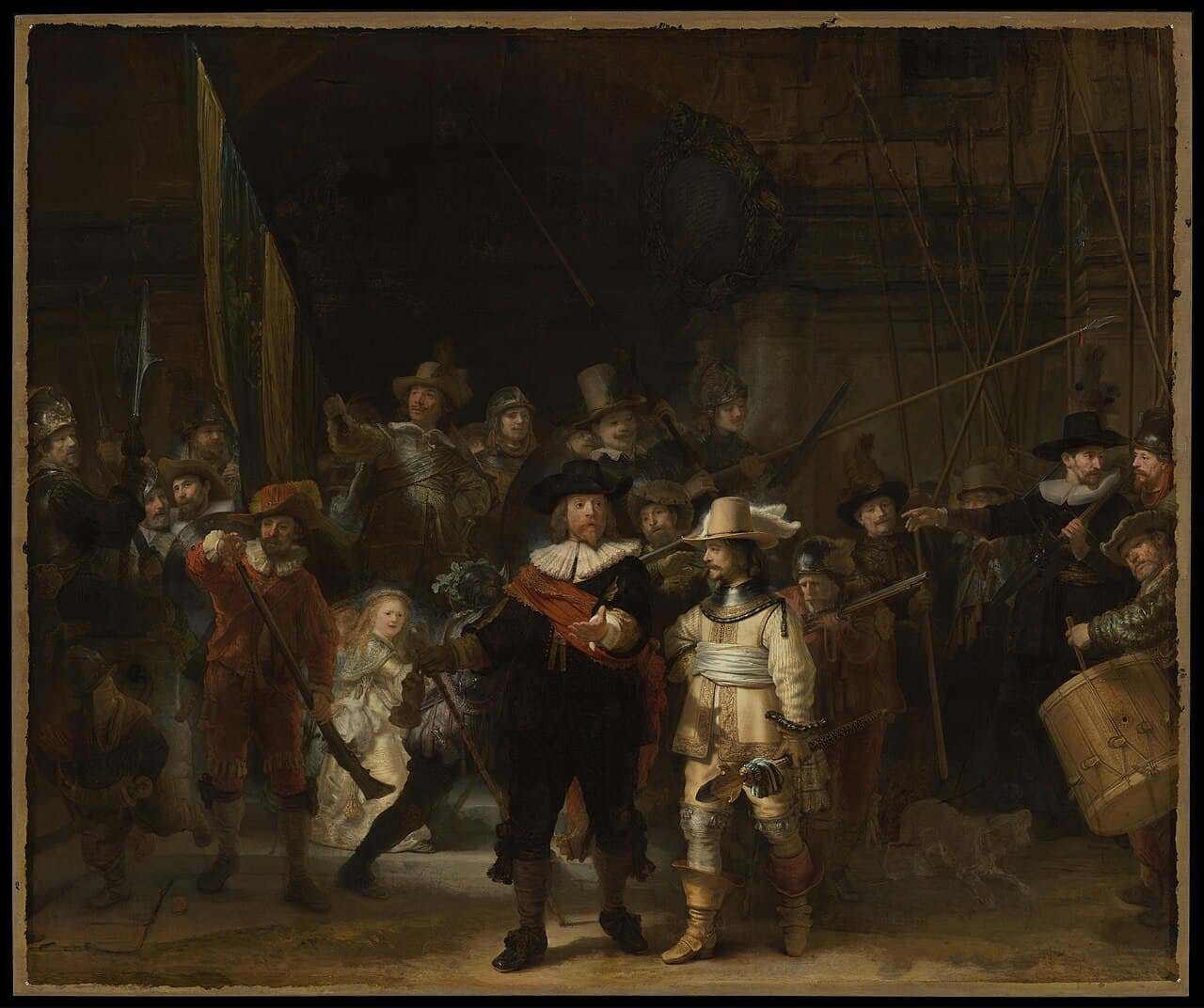
The Night Watch
The Night Watch (1642) is the most famous painting in the Netherlands, and its scale is part of the experience — over 11 feet tall and 14 feet wide. It depicts a militia company preparing to march, figures caught mid-motion, light and shadow animating the scene with a dynamism unprecedented in group portraiture. It turned a civic commission into a painting about the nature of collective action and individual identity.