San Giorgio Maggiore at Dusk: Monet's Venice in Dissolving Light
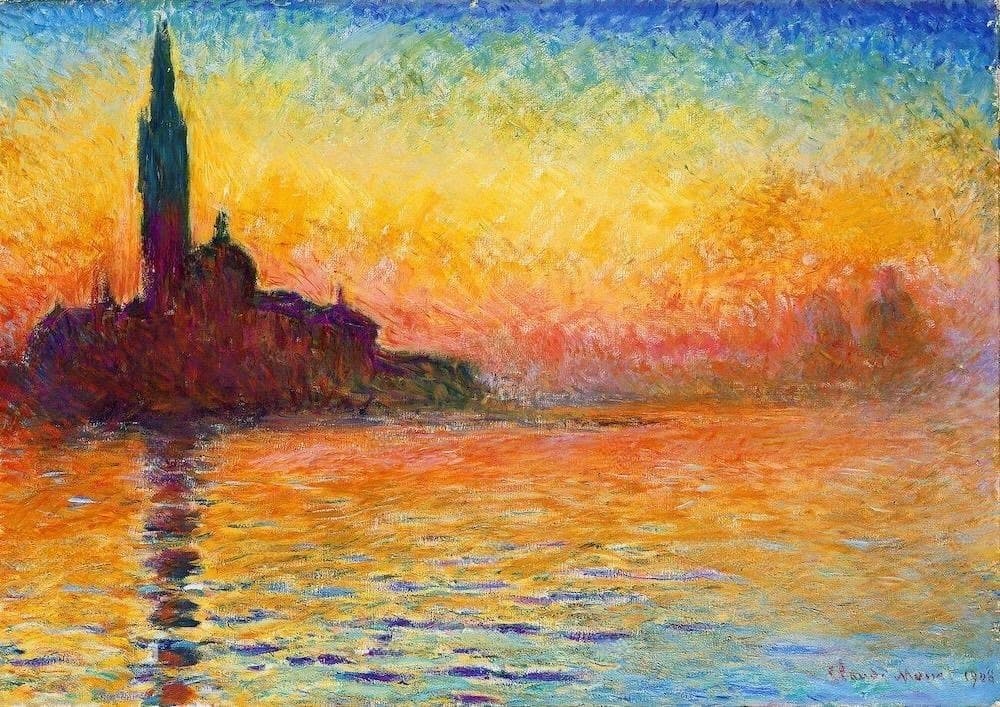
Painted in Venice in 1908, Monet's San Giorgio at Dusk captures the city's light at the precise moment it tips from gold into violet.
Masters of Light
- 1.Masters of Light: Five Artists Who Made Darkness Speak
- 2.Vermeer's Secret: Light, Silence, and the Everyday
- 3.Rembrandt: The Master of Light and Shadow
- 4.Claude Monet and the Language of Light
- 5.San Giorgio Maggiore at Dusk: Monet's Venice in Dissolving Light
- 6.Van Gogh's Garden at Arles: Color, Joy, and the South of France
Claude Monet arrived in Venice in October 1908 at the age of 68, accompanied by his wife Alice. He had been reluctant to go — he had long believed that Venice was unpainta ble, that it was too famous, too already-painted, that whatever he could do had already been done better by Turner. He was wrong, and he knew it almost immediately. He worked with a kind of urgency that surprised even him, producing thirty-seven canvases in under three months, many of them among the most radiant works of his career.
The Venice Series: A City Made of Light
Monet's Venice paintings are different from everything else he made. His earlier series — haystacks, Rouen Cathedral, the Thames, the water lilies — had all been concerned with the transformation of specific, familiar subjects by changing conditions of light. Venice offered him something unprecedented: a city that was itself already composed of light and water, a place where the boundaries between the built environment and its reflections were permanently unstable.
The lagoon around Venice functions as a vast mirror, doubling every surface, fragmenting every reflection in the movement of the water, making the city appear to float in its own image. For a painter whose entire practice had been organized around the instability of light, Venice was the perfect subject: a world already doing what he was trying to do.
San Giorgio Maggiore at Dusk: The Painting
The island of San Giorgio Maggiore sits directly across the Venetian lagoon from the Piazza San Marco. Palladio's church, begun in 1566, rises from the island in one of the great masterpieces of Renaissance architecture — its white Istrian stone facade designed to catch and hold the light across the water. Monet painted it multiple times during his Venice stay, under different conditions and at different hours. San Giorgio Maggiore at Dusk is the most celebrated of these canvases, and among the most beautiful paintings of his career.
The painting was made in 1908. The exact time of day Monet chose — the last light before darkness — was not accidental. Dusk over the Venetian lagoon is one of the most extraordinary optical phenomena in Europe: the sky moves through an almost implausible sequence of golds, ambers, pinks, and violets in the space of perhaps twenty minutes, the water below mirroring and modifying each shift. To paint it is to work in a state of emergency: the light is changing faster than the hand can move.
Dissolution as Style and Subject
The painting depicts the island and church from across the water, but "depicts" may be too strong a word. What Monet actually gives us is an impression — the sense of architectural presence at the threshold of visibility, the forms of the bell tower and facade legible enough to be identified but dissolved enough to feel like memory rather than direct observation. The sky above occupies more than half the canvas and blazes in horizontal bands of orange, gold, and the first traces of violet dusk. The water below is darker, more fractured, a broken mirror of what is above.
The technique is one of Monet's most purely Impressionist: individual brushstrokes visible, forms defined by color relationship rather than drawn edge, the surface of the canvas frankly present. And yet the image coalesces. The brain assembles Palladio's church from a hundred touches of pale grey-gold paint, a bell tower from a dark vertical stroke, a rippled reflection from horizontal dragged marks of orange and deep water-blue. The painting is about this act of assembly — about perception as an active process that constructs the world from fragments of sensation.
The Context: Late Monet and the Road to Abstraction
The Venice paintings occupy a significant position in the larger narrative of Monet's late career. They were made at the same time he was beginning to conceive the monumental Water Lilies panels, the project that would consume the last two decades of his life and produce works that subsequent generations of abstract painters — particularly the Abstract Expressionists of the 1940s and 50s — would recognize as direct predecessors.
San Giorgio Maggiore at Dusk is not quite an abstract painting. But it is very close to the point where representation dissolves entirely into color and gesture, which is perhaps why it continues to feel modern — indeed, contemporary — more than a century after it was made. The chromatic field of the sky, the way the architectural subject is present but not fully materialized, the equal weight given to the directly seen and the reflected: all of these prefigure not just the Water Lilies but Abstract Expressionism, Color Field painting, and the broader tradition of painting in which the physical act of applying color becomes the subject of the work.
Where the Painting Lives
San Giorgio Maggiore at Dusk is held in the collection of the National Museum Wales in Cardiff. Monet's Venice series was exhibited in Paris in 1912 to enormous acclaim; the paintings were recognized immediately as masterworks and have never fallen from that estimation. To stand in front of this canvas is to be inside a specific moment of light on the Venetian lagoon in October 1908 — which is, of course, impossible. But painting at its best makes the impossible available, briefly, to the eye.