Peonies by Alexander Sheversky: The Art of Floral Abundance
Sheversky's Peonies draws on Dutch Golden Age tradition — exuberant, technically dazzling, charged with the poignancy of beauty at its peak.
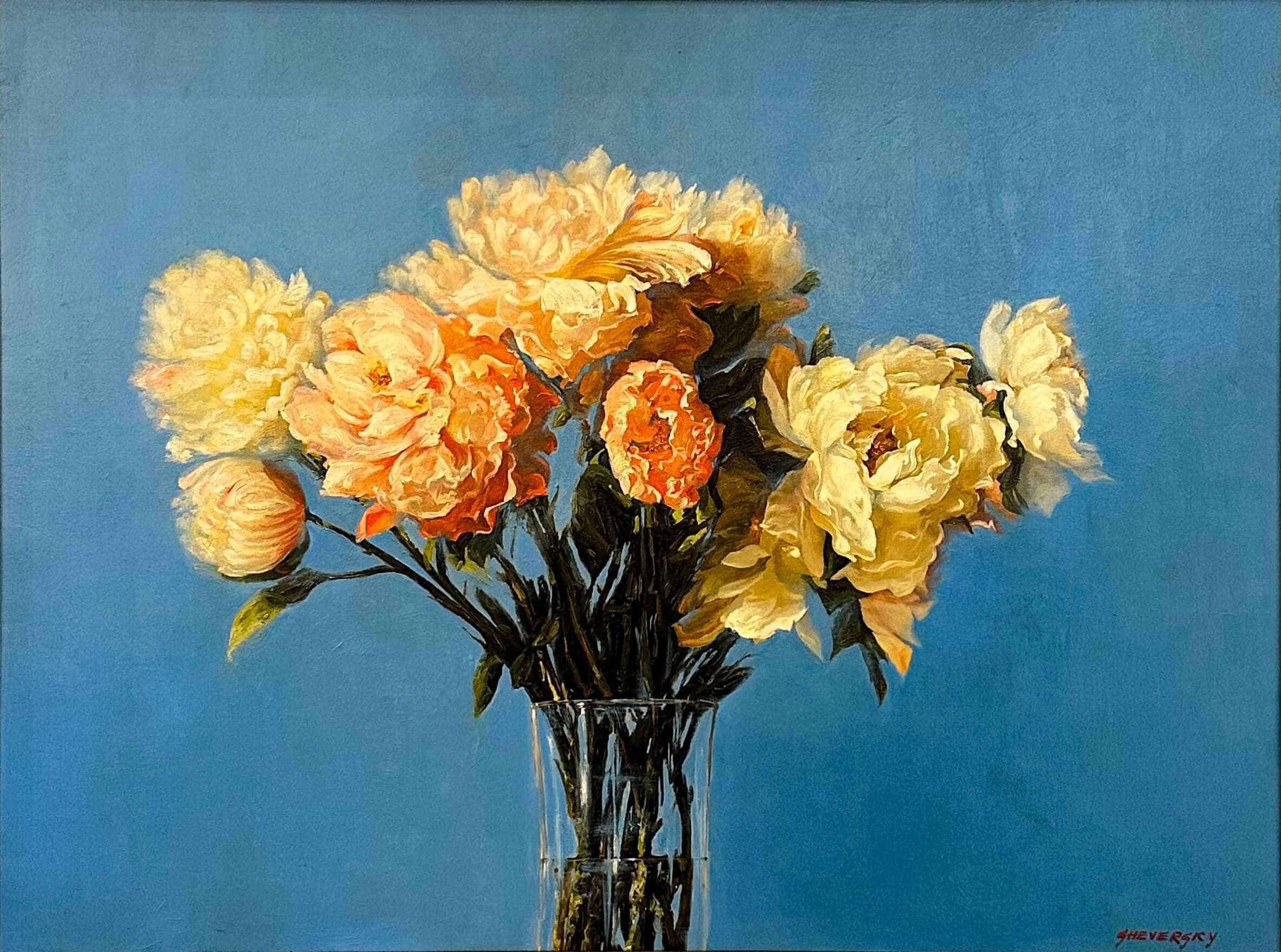
The peony has been called the "king of flowers" in Chinese culture for over a thousand years. In Western painting, it appeared as a symbol of prosperity, healing, and the dangerous excess of beauty — a flower so lush it seems always on the verge of collapse under its own weight. Alexander Sheversky's Peonies, painted in oil on canvas at 30 by 40 inches, makes full use of the flower's symbolic weight while demonstrating a level of technical mastery that places the work in direct conversation with the great floral painters of the Dutch Golden Age.
Alexander Sheversky: Realism as Devotion
Alexander Sheversky was born in Russia and trained in the rigorous tradition of Russian academic realism before developing his practice as a still-life and portrait painter working in North America. Russian academic training is among the most demanding in the world — it emphasizes extended study from life, mastery of the full tonal range, and a near-scientific understanding of how light behaves on different surfaces. All of this discipline is visible in Peonies, where the rendering of petals, stems, water droplets, and the varying textures of different varieties of bloom reveals a painter who has spent years learning how to see.
But Sheversky is not merely a technician. The paintings he chooses to make — and the choices he makes within them — reveal an artist for whom realism is a form of devotion: an act of sustained attention to the beauty of the material world that transforms careful observation into something close to reverence.
Composition: The Dutch Tradition Revisited
The compositional logic of Peonies draws directly on the tradition established by Jan van Huysum, Rachel Ruysch, and the great floral painters of seventeenth-century Holland. Flowers are arranged in a loose pyramid or bouquet form that suggests natural abundance while carefully controlling the distribution of light and colour across the picture plane. Dark backgrounds isolate the blooms against shadow, making each flower read as a luminous object rather than a flat pattern.
What Sheversky brings to this tradition is a contemporary fluency — the bouquet in Peonies has a looseness and informality that the Dutch masters, working from assembled specimens in winter studios, could not always achieve. The peonies feel freshly cut, their stems still holding the suppleness of recently living wood, their petals open at different stages in a way that suggests they were painted quickly, before the flowers could fade.
Light on Petals: The Technical Achievement
The central technical challenge of floral still life painting is the rendering of petals — translucent, thin, varying in color from the bright outer surface to the shadowed interior folds. Sheversky meets this challenge with a virtuosity that rewards close inspection. The petals in Peonies are not simply painted pink or white; they contain blues, yellows, creams, and warm shadows that make them read as genuinely three-dimensional, genuinely organic surfaces.
The light in the painting appears to come from the upper left — a classic compositional choice that casts the flowers in a clear, directional illumination that creates strong highlights on the turned faces of the outer petals and deep, rich shadows in the interior of the blooms. These shadows are never simply dark; they contain color — the warm reflected light from nearby petals, the cool blue of ambient skylight — and it is this coloristic complexity in the shadows that makes the painting feel lit rather than merely illustrated.
The Peony's Symbolism and Sheversky's Intent
Peonies bloom for a short, intense period in late spring. Their flowers open quickly and fall almost as quickly; the fully opened bloom is also the bloom closest to dropping its petals. This relationship between peak beauty and imminent decline is central to the peony's symbolic resonance across cultures — it is a flower that insists on its own transience.
Sheversky's decision to paint peonies at their fullest, most extravagant state is therefore not a simple celebration of beauty. It is a painting about a particular moment: the peak that is already the beginning of the end. This is the theme that connects the tradition of floral still life painting to the larger tradition of vanitas — the meditation on impermanence that runs through so much of Western art. Sheversky does not labour the point; he lets the flowers make it. But it is there, quietly, in every opened bloom.
Scale and Presence
At 30 by 40 inches, Peonies is a painting that imposes itself on a room. The flowers are rendered at roughly life-size, which means that standing in front of the canvas is something like standing in front of an actual bouquet — except that the bouquet will not fade, its peak will not pass, the petals will not fall. The painting holds the moment of fullness permanently, which is both what all painting does and, in this particular case, the deepest thing the work has to say.