Iris Field by Olivia Zeng: A Commission Born from Pure Color
Olivia Zeng's Iris Field transforms a floral commission into a meditation on color, atmosphere, and the pure joy of irises in full bloom.
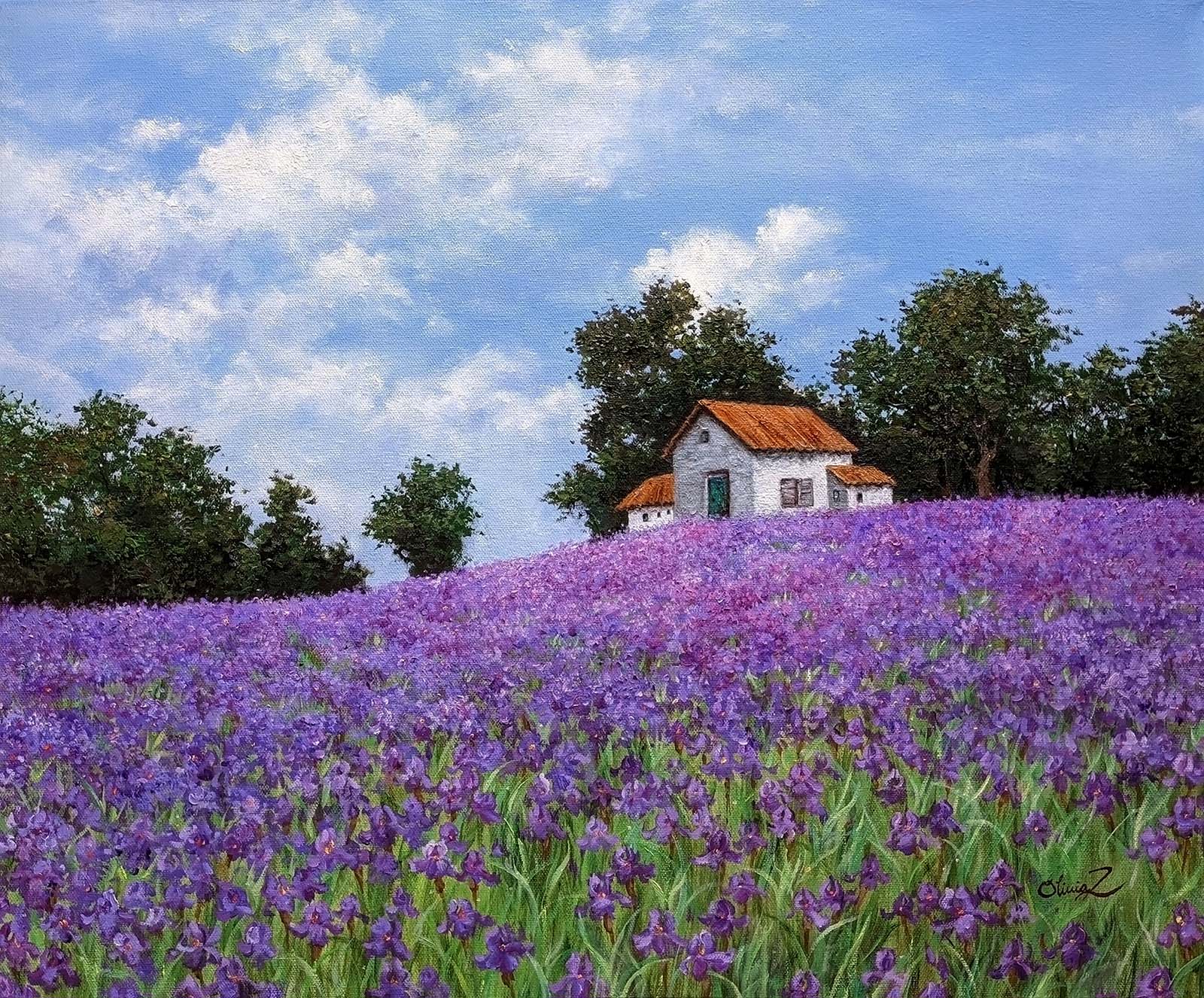
A field of irises in full bloom is one of the most visually overwhelming experiences the natural world offers. For a few weeks each spring, the landscape becomes saturated with purples, blues, and whites so intense they seem almost artificial — a natural excess that has attracted painters from Van Gogh to Monet. Olivia Zeng's Iris Field, painted in oil on canvas at 20 by 24 inches, approaches this subject with a freshness and directness that makes it feel newly discovered rather than revisited.
The Commission: Painting to an Intention
That Iris Field was created as a commission is worth noting at the outset. Commissioned painting occupies a complex position in contemporary art — less prestigious than the freely chosen work that defines an artist's personal vision, but with a long and honourable history going back to the great patrons of the Renaissance. The best commissioned paintings are not compromises between what the artist wants to make and what the client wants to own; they are works in which client desire provides the constraint within which the artist's instincts find their fullest expression.
Iris Field feels like exactly that kind of work. Whatever the original brief was, the painting that resulted belongs entirely to Olivia Zeng's visual sensibility. The commission gave her a subject; what she made of it is entirely her own.
Color as the Primary Subject
In Iris Field, Zeng makes color — rather than form or narrative — the primary carrier of meaning. The irises themselves are rendered with enough specificity that they are immediately identifiable, but Zeng resists the temptation of botanical precision. Individual blooms dissolve into passages of violet and blue-purple at the edges of the composition, the field extending beyond the frame as if the painting is a window onto something too large to contain.
The greens of the stems and leaves provide the structural armature of the composition, creating vertical rhythms that organize the pictorial space and prevent the color from becoming purely atmospheric. But these greens are never mechanical: they shift from yellow-green in the lightest passages to near-black in the deepest shadows, carrying as much tonal complexity as the flowers themselves.
Light and the Impressionist Inheritance
Zeng's handling of light in Iris Field places her clearly within the Impressionist tradition — not as a stylistic imitation but as a genuine inheritor of that tradition's fundamental concern: the way light transforms the appearance of things moment by moment. The light in the painting feels specific to a time of day, probably mid-morning when the sun is high enough to create clear highlights on the upper petals but still at a low enough angle to cast meaningful shadows.
This specificity of light is what lifts the painting above the category of "pretty floral." It is not a painting of irises in the abstract; it is a painting of these irises, in this light, at this moment. The Impressionists understood that specificity of this kind is what makes a painting feel real rather than merely accurate — and Zeng understands it too.
The Intimacy of the 20 by 24 Format
At 20 by 24 inches, Iris Field is a painting sized for intimate viewing. The irises are not quite life-size but close enough that the viewer feels physically near them — at the scale of someone who has crouched down to look carefully at a flower rather than walking past a field. This choice of scale is significant. It positions the viewer not as a surveyor of a landscape but as a participant in a close and attentive encounter with the natural world.
That intimacy is perhaps the painting's deepest quality. In an era when attention is perpetually diffused across screens and notifications, Iris Field asks for — and rewards — the simple act of stopping and looking carefully at something beautiful.
Olivia Zeng and the Zeng Legacy
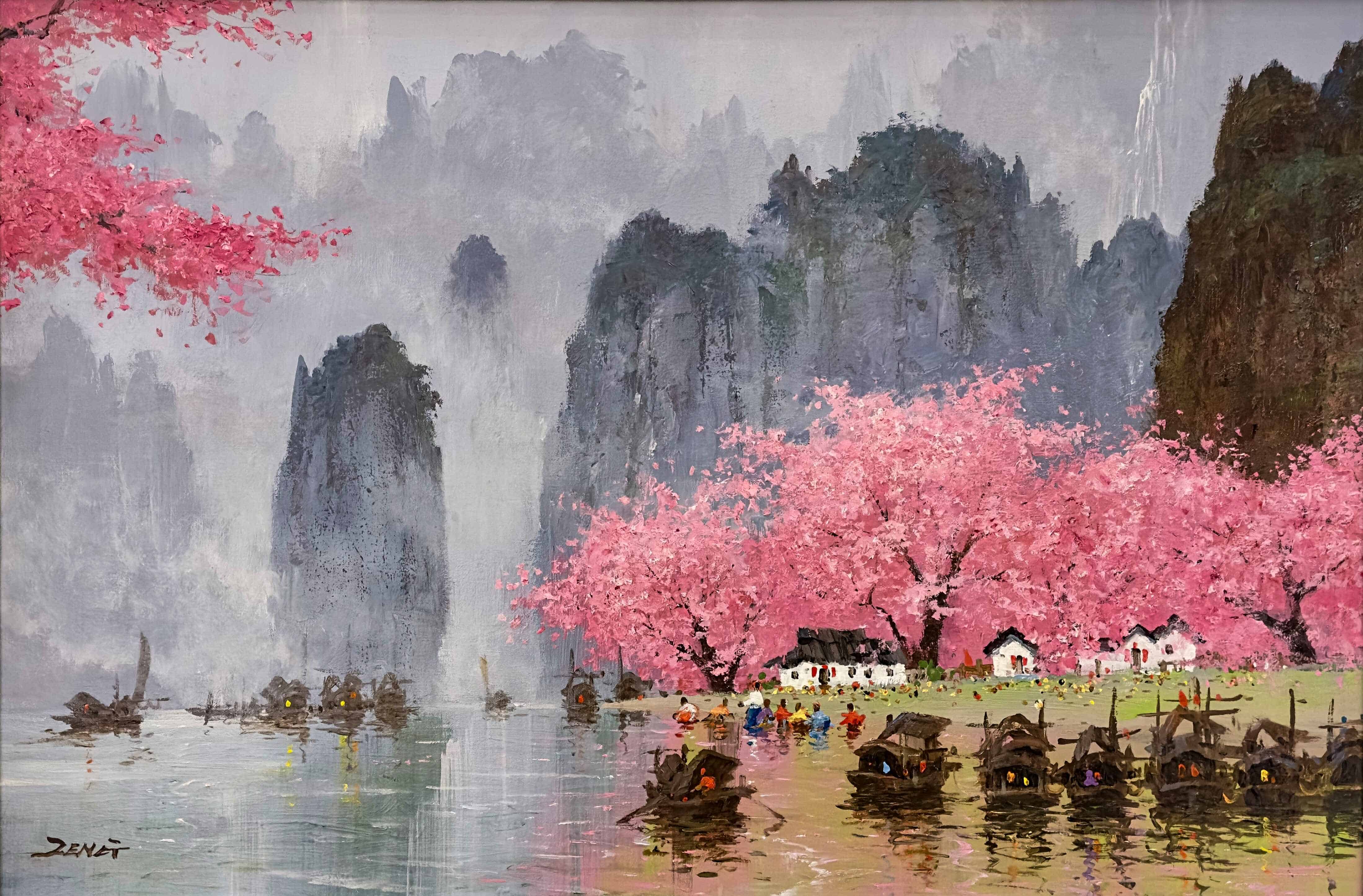
Olivia Zeng belongs to a lineage of painters deeply engaged with the intersection of Chinese aesthetic sensibility and Western oil-painting technique — a lineage that includes Uncle Zeng, whose Peach Blossom Spring engages similar questions of cultural translation from a different angle. Where Uncle Zeng's work tends toward the atmospheric and the mythic, Olivia Zeng's approach in Iris Field is more immediate, more sensory, more firmly rooted in the physical pleasure of color and light. Together, their work represents a richly productive dialogue between traditions — not a synthesis in any forced sense, but a conversation that continues to produce results worth attending to.