Peach Blossom Spring by Uncle Zeng: A Utopia Painted in Oil
Uncle Zeng transforms an ancient Chinese myth into a luminous oil painting that blurs the boundary between memory, longing, and paradise.
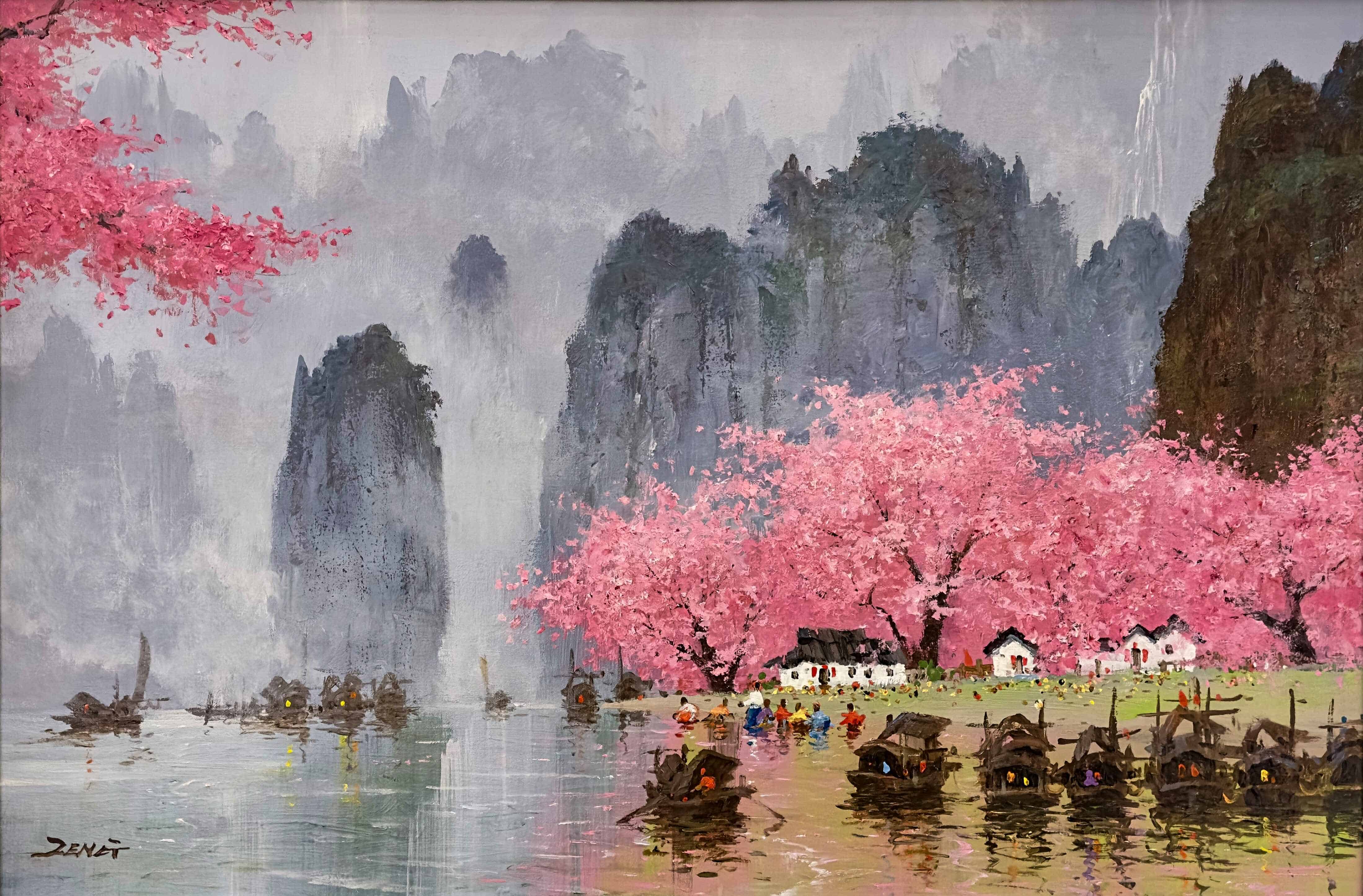
Some paintings do not simply depict a place — they create one. Peach Blossom Spring by Uncle Zeng is exactly that kind of work: a canvas that pulls the viewer into a world that feels more real than reality, a realm of pink-drifted light and still water that the eye wants to enter and never leave.
The Literary Source: Tao Yuanming's Eternal Tale
To understand Uncle Zeng's painting fully, one must first know the story it invokes. In 421 AD, the Chinese poet Tao Yuanming wrote Peach Blossom Spring — a short prose poem about a fisherman who, while following a stream lined with peach trees in full bloom, discovers a hidden valley. Inside, a self-sufficient community has lived untouched by war, taxation, and the suffering of the outside world for generations. The fisherman stays for a time, then leaves and tries to return — but the valley is never found again.
The story has haunted Chinese literary and artistic imagination for sixteen centuries. It is the Chinese archetype of utopia: not a constructed perfection but an accidentally found one, a place that exists not by design but by grace, and that cannot be revisited once left. Every generation of Chinese painters has found something new to say about it, and Uncle Zeng finds something that feels entirely his own.
Reading the Canvas: Composition and Light
Painted in oil on canvas at 24 by 36 inches, Peach Blossom Spring uses a horizontal format that mimics the scroll-like proportions of traditional Chinese landscape painting — a visual echo that grounds the work in its cultural inheritance even as it operates within a Western medium. The eye enters from the lower left along a dark passage of water and moves upward and right into an expanding field of blossom-light.
Uncle Zeng does not paint individual peach flowers with botanical precision. Instead, he layers passages of pink, white, and soft gold into atmospheric clouds of color that hover above the water's surface. The technique recalls Monet's late water lily panels — color as sensation rather than description — but the mood is different: warmer, more intimate, less meditative and more yearning.
The water below the blossoms is painted in deep tones of teal and grey-green, perfectly still, a mirror that doubles the light above. This reflective surface is one of the painting's key psychological devices: the world portrayed is already doubled, already existing in two registers at once — the material and the immaterial, the seen and the imagined.
Uncle Zeng's Technique: Oil as Ink
Uncle Zeng was trained in traditional Chinese ink painting before moving into oils, and that training is visible in every brushstroke. Where Western oil painters typically build form through layered impasto or careful glazing, Zeng works with a fluidity that suggests the spontaneous, breath-controlled marks of ink on paper. Edges dissolve rather than define. Forms emerge from color rather than line.
This hybrid sensibility is not decorative pastiche — it represents a genuine integration of two visual traditions. The oil medium gives Zeng access to a depth of tone and luminosity that ink cannot achieve, while his ink-painting instincts prevent the work from becoming merely technical. The result is painting that feels both ancient and utterly present.
What the Painting Withholds
Crucially, there are no figures in Peach Blossom Spring. The hidden community, the fisherman, the path itself — all are absent. What Zeng gives us is the threshold, the moment before arrival: blossoms and water, light and its reflection, the invitation of a passage that leads somewhere beyond the frame. The painting is structured as a question: Would you go in?
This deliberate withholding is what makes the work so effective as an evocation of Tao Yuanming's original story. The poem's deepest subject is not what the valley contains but the impossibility of returning to it. Zeng captures that loss not by depicting absence but by making presence so overwhelming that you feel the pain of never being able to hold it.
Why This Painting Endures
In an era saturated with images that demand immediate recognition and reward quick interpretation, Peach Blossom Spring asks for something rarer: sustained attention and a willingness to feel lost. It is a painting about the relationship between beauty and impermanence, about the places — physical, emotional, imagined — to which we can never truly return. Uncle Zeng has made that relationship visible in 24 by 36 inches of oil on canvas, and it is more than enough.