Frida Kahlo: Pain, Identity, and Bold Color
Kahlo turned personal suffering into one of the twentieth century's most powerful visual languages — unflinching and unmistakably her own.
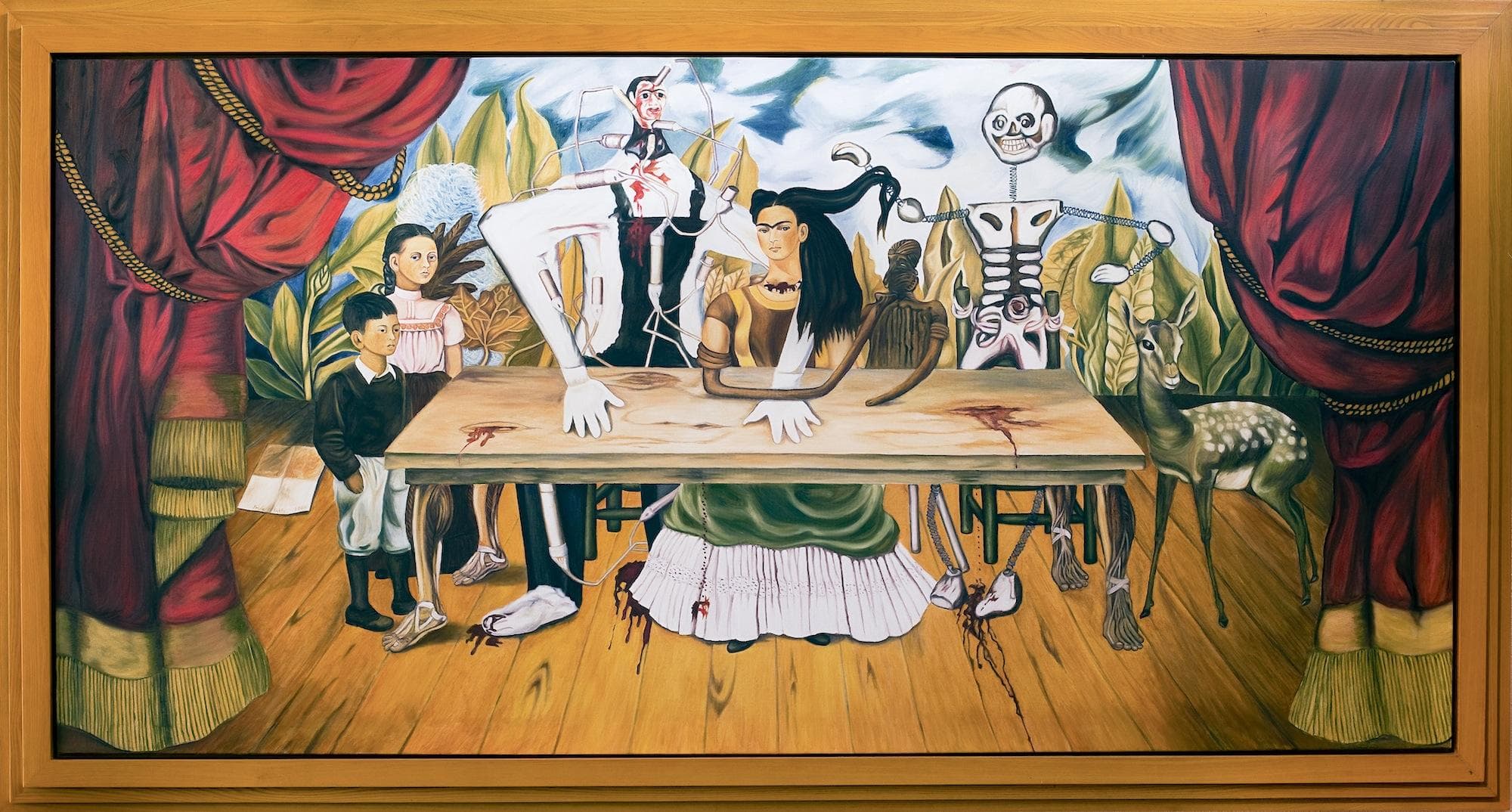
Frida Kahlo completed 143 paintings, of which 55 are self-portraits. "I paint myself because I am so often alone," she said, "and because I am the subject I know best." But her self-portraits are not confessional in any simple sense — they are carefully constructed images that use her body as a site for exploring pain, identity, politics, and the complicated relationship between Mexican and European culture.
The Accident and the Aftermath
In 1925, at 18, Kahlo was severely injured in a bus accident. She suffered a broken spinal column, collarbone, ribs, and pelvis, along with eleven fractures in her right leg. She would undergo more than 35 surgeries in her lifetime. During her long recoveries, confined to bed, she began to paint — her mother had a special easel made so she could work lying down.
Pain became not just a subject but a medium. Works like The Broken Column (1944) and Without Hope (1945) render physical anguish with a directness that can be difficult to look at, and impossible to forget.
Symbolism and Mexican Identity
Kahlo's paintings are dense with symbolism drawn from Mexican folk art, pre-Columbian imagery, Catholic iconography, and surrealist motifs. She wore traditional Tehuana dress not merely as fashion but as a political statement — an assertion of indigenous Mexican identity against European influence.
André Breton called her work surrealist, but Kahlo rejected the label. "I never painted dreams," she said. "I painted my own reality." The distinction matters: her imagery, however fantastical it appears, is always rooted in lived experience.
Rediscovery and Legacy
During her lifetime, Kahlo's fame was largely overshadowed by her husband Diego Rivera. Her major retrospective recognition came posthumously, accelerating in the 1970s and 1980s as feminist art history recovered her work. Today she is among the most recognized artists in the world — her face on merchandise, her name invoked in countless contexts. The challenge for viewers now is to get past the icon and encounter the paintings themselves: difficult, precise, and quietly radical.